
Welcome
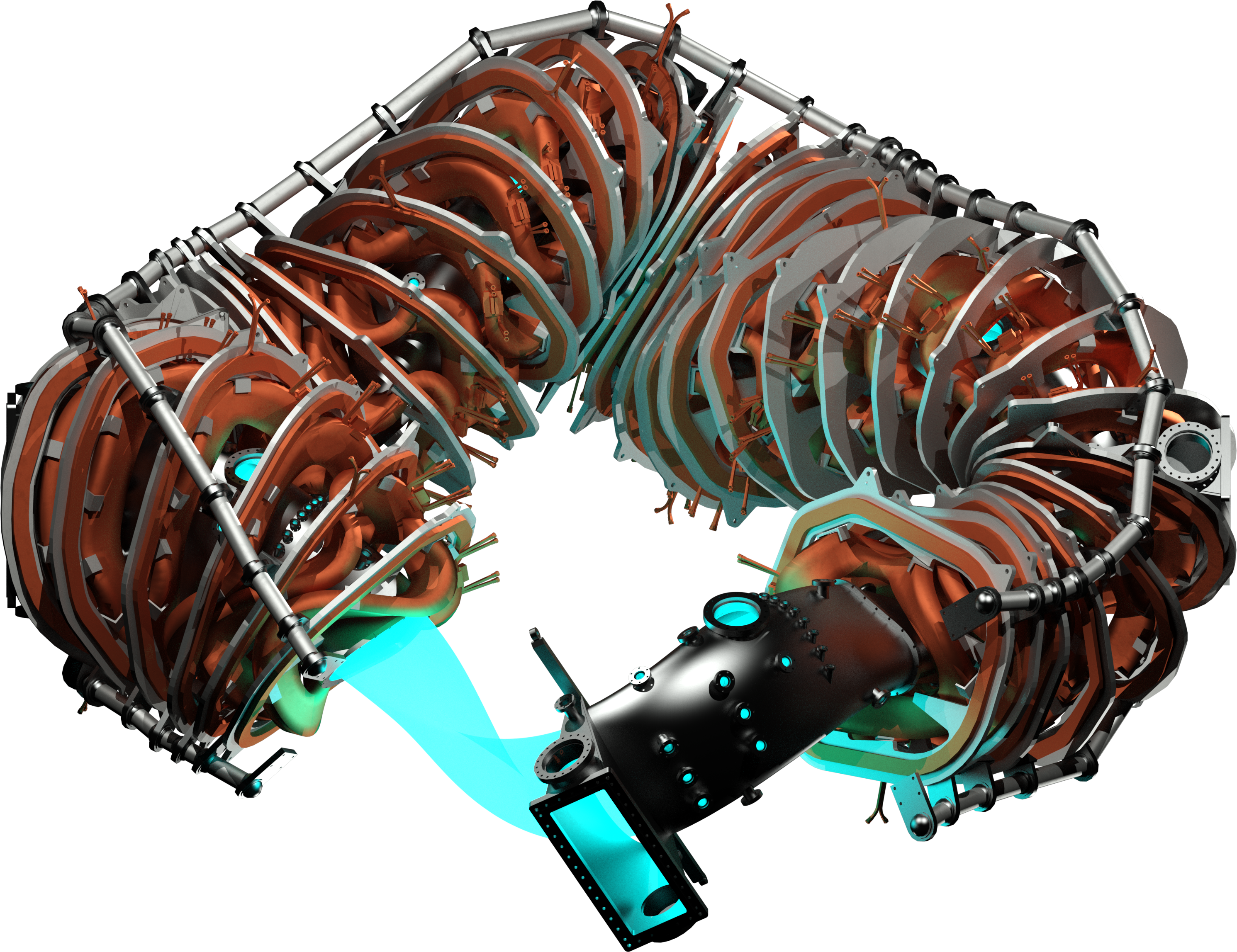
The Helically Symmetric eXperiment (HSX) is an optimized stellarator operated by the College of Engineering at UW–Madison. 3D shaped coils are arranged in a torus-like configuration to produce a 1 Tesla magnetic field that confines a plasma with temperatures higher than 10 Million degrees C. The goal of the experiment is to contribute to the physics basis of a future power plant which produces energy by fusing Hydrogen isotopes to Helium.
Latest News
8/31/26:
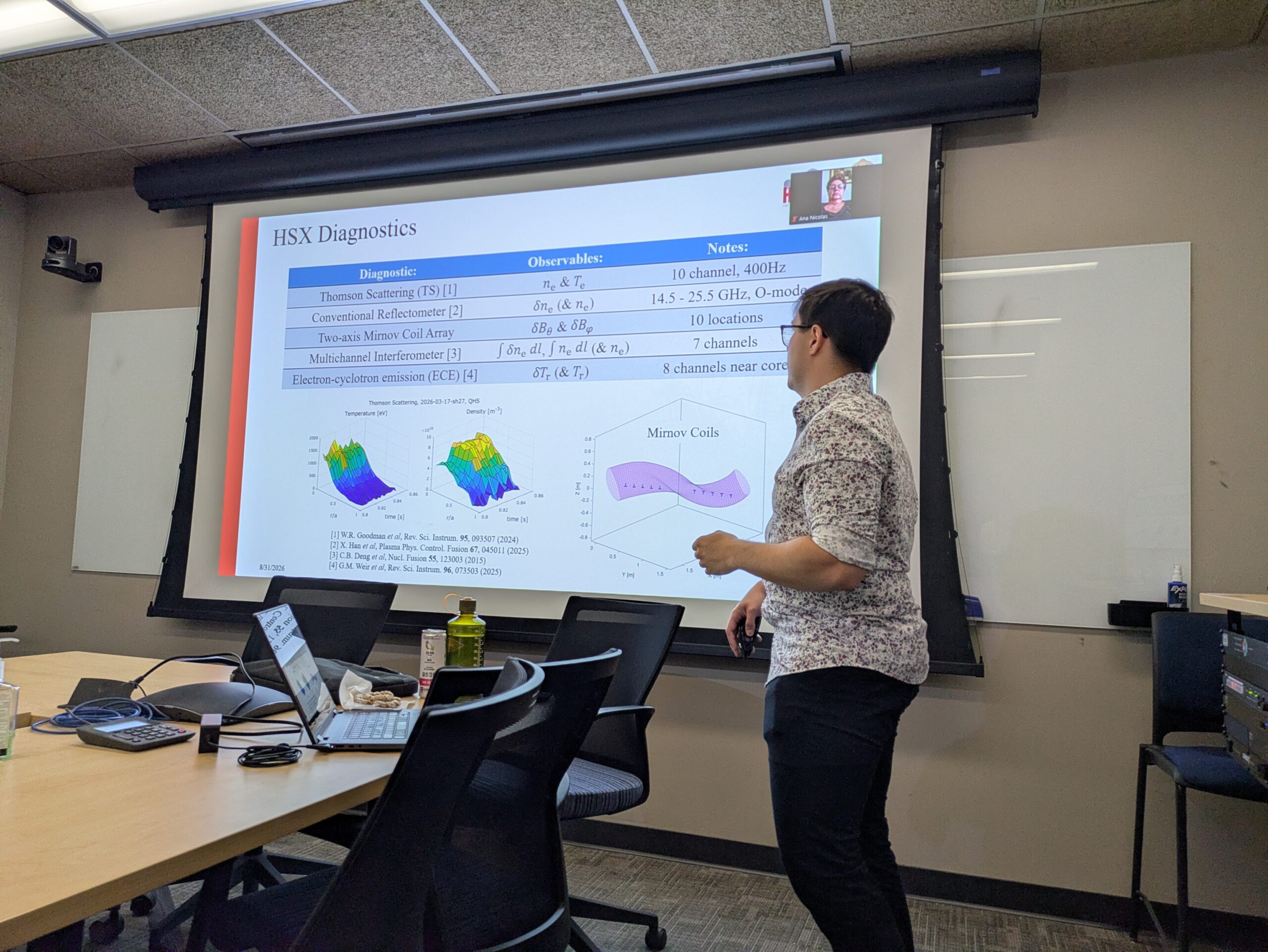
At the end of August, Henrique Hillebrecht successfully defended his PhD thesis, “Experimental Investigation of Turbulent Transport in a TEM-Optimized Configuration of HSX.” Congratulations Henrique!
What is helical symmetry?
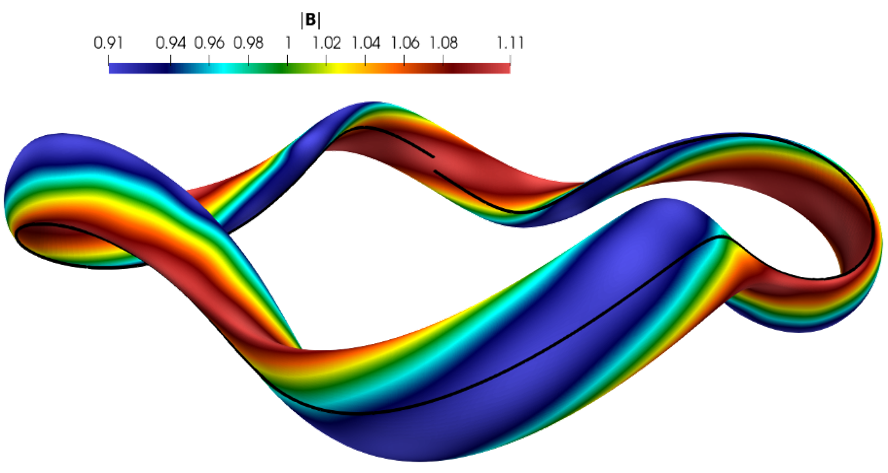
HSX is the only device in the world that has a magnetic field structure described as Quasi-Helically Symmetric (QHS) where high and low-field regions of the magnetic field structure wrap around the device helically (see picture above). This allows particles to “see” a quasi-symmetric magnetic field structure which provides excellent confinement properties.
Research
Plasma physics research at HSX focuses on studies of turbulent transport, as well as the generation and damping of plasma flows in the 3D magnetic field geometry.
Video showing the perturbed electrostatic potential inside HSX, as simulated by the turbulence code GENE.
Device Parameters
| Major Radius (machine center to Plasma center): | 1.20 meters |
| Average Plasma Minor Radius: | 0.12 meters |
| Aspect Ratio (Major Radius/Plasma Radius): | 10 |
| Plasma Volume: | 0.44 cubic meters |
| Number of Field Periods (symmetry around torus): | 4 |
| Rotational Transform on axis: | 1.05 |

